Lisbon: Sintra Cascais & Pena Palace Small Group Tour
3.239 reviews
Buy now
From 49,00€ per person

Portugal is one of Europe’s most visited countries, welcoming tens of millions of tourists each year from across the globe, drawn to its Atlantic coastline, the vibrant energy of Lisbon and Porto, the beaches of the Algarve, and the islands of Madeira and the Azores. Before you travel, it’s essential to know which documents you’ll need to enter the country, as entry requirements vary significantly depending on your nationality.
Portugal is a member of the European Union and part of the Schengen Area, which simplifies entry for EU citizens but imposes strict rules for those arriving from outside, including UK citizens following Brexit. From 2025, new external border control measures have come into force — the EES system — which changes the entry experience for non-EU travellers. This guide covers everything you need to know before you travel.
If you’re a citizen of one of the 27 EU member states — including France, Germany, Spain and all others — entering Portugal is straightforward. The freedom of movement guaranteed by EU treaties allows you to travel and stay without time restrictions, without a visa, and without needing to justify the purpose of your visit.
The required document is a valid national identity card or a valid passport. Your document doesn’t need to be valid for a long time after your trip — it simply needs to be valid when you enter. However, to avoid any complications, it’s always advisable to travel with documents that have at least six months of validity remaining, especially if you plan to make stops at non-EU airports.
EU citizens who intend to stay in Portugal for more than three months must register with the Câmara Municipal (Town Hall) of their place of residence, obtaining a Certificado de Registo de Cidadão da União Europeia. This is a bureaucratic requirement that doesn’t apply to tourists, but it’s worth knowing if you’re planning a medium to long-term move.
The same rules apply to citizens of Norway, Iceland and Liechtenstein (non-EU EEA countries) and Switzerland, which have free movement agreements with the European Union. A valid national identity card or passport is sufficient for them as well, with no visa required.
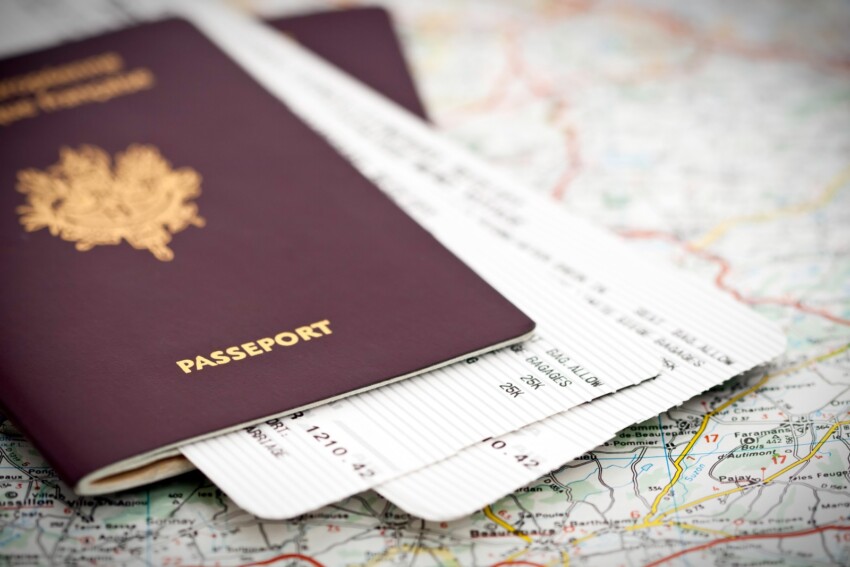
Many countries worldwide have visa exemption agreements with the Schengen area, allowing their citizens to visit Portugal — and the other 29 Schengen countries — for short periods without needing to apply for a visa in advance. This includes citizens of the United States, Canada, Australia, New Zealand, Japan, South Korea, Brazil, Argentina, Mexico and numerous other countries.
An essential document is a valid passport, with an expiry date that extends at least three months beyond your planned exit date from the Schengen area. Check your passport expiry date carefully before buying tickets: many airlines refuse to board passengers who don’t meet this requirement.
Non-EU citizens exempt from visa requirements can stay in the Schengen area for a maximum of 90 days within any 180-day period. This limit applies to all Schengen countries combined, not just Portugal: if you’ve already spent 30 days in Spain, you can stay another 60 days in Portugal (or any other Schengen country) before you must leave the area.
The day count is strict and doesn’t take into account your reasons for staying. Exceeding the 90-day limit constitutes a breach of entry regulations and can have serious consequences, including a ban on re-entering the Schengen area. Use one of the online calculators available on the official EU website to keep track of days you’ve already spent.
From 12 October 2025, the new European entry and exit registration system, known as the EES (Entry/Exit System), has been rolled out gradually. This is a biometric digital system that records passport data, photographs and fingerprints of all non-EU citizens entering or leaving the Schengen area for short stays.
The EES replaces traditional passport stamps with electronic registration. In practice, when you first arrive after the system’s activation, you’ll be asked to scan your passport, have your photograph taken and provide your fingerprints. The process takes a few minutes longer than before, which is why airports recommend arriving with extra time before your flight.
Full implementation across all 29 Schengen countries is expected by 10 April 2026. Portugal, in particular, encountered some initial difficulties: Lisbon airport temporarily suspended the system in December 2025 due to excessive queues, though it later resumed with additional staff. If you arrive in Portugal over the coming months, allow for potentially longer wait times at border controls.
In the second half of 2026, the ETIAS (European Travel Information and Authorisation System) will come into force — an electronic pre-travel authorisation system similar to the American ESTA or Canadian eTA. ETIAS will be mandatory for all non-EU citizens exempt from visa requirements who want to enter the Schengen area, including Portugal.
You apply for authorisation online before departure in a straightforward process that takes about 10 minutes. The fee is €20 (those under 18 and over 70 are exempt). Once approved, ETIAS is valid for three years or until your passport expires, and allows multiple entries. Most applications are approved within a few hours.
It’s important to note that ETIAS is not yet mandatory at the time of publication of this guide (February 2026). Official launch is scheduled for the fourth quarter of 2026, but it will remain optional for the first six months, becoming fully mandatory approximately in the first half of 2027. Always check the official EU ETIAS website before travelling for the most up-to-date information.
Citizens of countries not on the Schengen area’s visa exemption list must apply for a Schengen visa before travelling to Portugal. You obtain the visa from the Portuguese Consulate or Embassy in your country of residence, or from the diplomatic representation of the competent Schengen country for your geographic area.
The Schengen tourist visa (category C) permits stays of up to 90 days throughout the Schengen area, under the same 90/180-day rules described above. You must submit your application in advance — at least 3-4 weeks before departure is recommended — and it typically requires several documents including the completed application form, a valid passport, passport-style photographs, flight and accommodation bookings, proof of financial means, and travel insurance with minimum cover of €30,000.
Fees and processing times vary by country and time of year. Always contact the relevant Portuguese diplomatic representation for your area or consult the official Portuguese visa portal for updated instructions.
Following Brexit, British citizens no longer benefit from European freedom of movement. However, the UK is included on the visa exemption list for the Schengen area, meaning you can enter Portugal without a visa for stays of up to 90 days in 180, exactly like American or Australian citizens.
The required document is a valid passport (British identity cards are not accepted for international travel outside UK territory). Like all non-EU citizens, British citizens will also be subject to the EES and, when it becomes mandatory, to ETIAS. If you plan to travel frequently in Europe, it’s worth monitoring developments on the UK government’s website (gov.uk/foreign-travel-advice/portugal) and the official European portal.
Madeira and the Azores are autonomous regions of Portugal and are fully part of the European Union, so entry requirements are identical to those for mainland Portugal. EU citizens enter with a national identity card or passport; non-EU citizens exempt from visa requirements with a valid passport; those requiring a visa must obtain it before departure.
It’s worth noting that whilst these islands belong to the eurozone and the EU, they are outside EU customs territory, which results in some differences regarding allowances for purchased goods. For internal flights between the islands and mainland Portugal, document checks are not required for EU citizens, though it’s always advisable to carry an identity document.

EU citizens are not required to have insurance to enter Portugal, but it’s highly recommended to carry the European Health Insurance Card (EHIC). For those applying for a Schengen visa, however, travel insurance with minimum cover of €30,000 is legally mandatory. Consult our guide on travel insurance for Portugal for all the details.
UK citizens should note that the EHIC is no longer valid following Brexit. It has been replaced by the GHIC (Global Health Insurance Card), which covers necessary medical treatment in Portugal at the same cost as local residents. The GHIC is free to apply for via the NHS website and is valid for five years. It does not cover private healthcare or repatriation costs, so taking out additional travel insurance is strongly recommended.
Regardless of your nationality, it’s good practice to make copies of all your documents and keep them separately from the originals, or save a secure digital copy in the cloud. In case of loss or theft, this precaution significantly speeds up replacement procedures at your consulate.
If you’re flying to Faro airport, Porto airport or Madeira airport and you’re a non-EU citizen, allow extra time for border controls during the EES rollout period. Wait times can increase significantly during peak hours and summer months. Carry your accommodation booking and return ticket with you, as border authorities may request these as proof of your temporary stay.




 Hotel
Hotel  Budget accommodations
  Apartments
  Family Hotel
  Luxury Hotel